
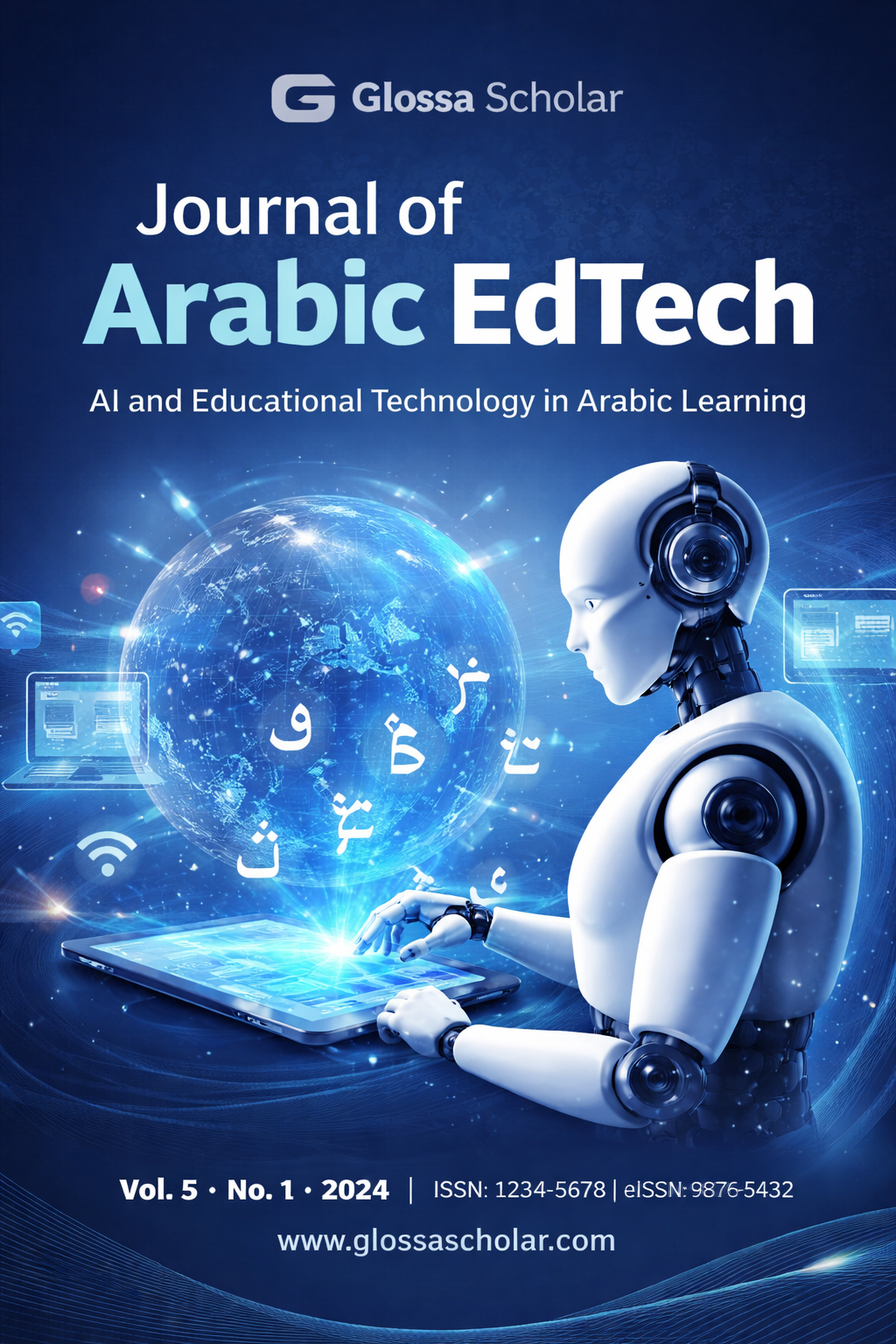
Publication Ethics
Journal of Arabic EdTech (JAET) is committed to maintaining the highest standards of publication ethics and integrity in scholarly publishing. The journal adheres to internationally recognized best practices in academic publishing and upholds principles of transparency, accountability, and scholarly responsibility. This statement outlines the ethical responsibilities of authors, reviewers, editors, and the publisher.
1. Responsibilities of Authors
Authors submitting manuscripts to JAET must ensure that: The manuscript is original and has not been published or submitted elsewhere. All sources are properly cited and referenced. Data are accurate, authentic, and not fabricated, falsified, or manipulated. Authorship reflects significant scholarly contribution. All co-authors have reviewed and approved the final manuscript. Any conflicts of interest are disclosed. Research involving human participants has received appropriate ethical approval where required. Plagiarism, self-plagiarism, data fabrication, and duplicate submission constitute serious ethical violations and may result in rejection or retraction.
2. Responsibilities of Editors
Editors are responsible for: Making publication decisions based solely on academic merit and relevance to the journal’s scope. Ensuring fair, unbiased, and confidential peer review. Maintaining confidentiality of submitted manuscripts. Avoiding conflicts of interest in editorial decisions. Taking appropriate action in cases of suspected misconduct. Editorial decisions must not be influenced by the authors’ nationality, institutional affiliation, race, gender, or political beliefs.
3. Responsibilities of Reviewers
Reviewers must: Provide objective, constructive, and timely evaluations. Maintain confidentiality of manuscript content. Identify relevant published work not cited by the authors. Declare any conflicts of interest and withdraw if necessary. Avoid using unpublished materials for personal advantage. Peer review is conducted under a double-blind system to ensure impartiality.
4. Publisher Responsibilities
The publisher, Kaman Glossa Inovasi, supports editorial independence and ensures that commercial or institutional interests do not influence editorial decisions. The publisher is committed to: Ensuring transparency in journal governance. Supporting ethical publishing standards. Maintaining digital preservation and DOI registration. Addressing ethical complaints in a fair and systematic manner.
5. Handling of Ethical Misconduct
JAET takes allegations of research or publication misconduct seriously. When concerns arise, the journal will: Conduct a preliminary assessment. Request clarification from the authors. Consult reviewers or editorial board members when necessary. Follow established procedures for correction, retraction, or withdrawal where appropriate. Serious ethical breaches may result in: Rejection of the manuscript. Retraction of published articles. Notification to authors’ institutions if required.
6. Corrections and Retractions
If errors are identified after publication, JAET will issue corrections, expressions of concern, or retractions in accordance with international best practices. All corrections and retractions will remain permanently linked to the original article and DOI to maintain transparency in the scholarly record.
7. AI and Emerging Technologies Disclosure
Authors must disclose the use of AI-assisted tools in manuscript preparation. AI tools may not be listed as authors and may not be used to generate data or fabricate research findings. The responsibility for the integrity and originality of the manuscript remains entirely with the authors.
8. Commitment to Ethical Scholarship
JAET is dedicated to fostering ethical research practices, responsible authorship, and transparent scholarly communication. The journal supports the advancement of knowledge in Arabic language education and educational technology through integrity, rigor, and international collaboration.