
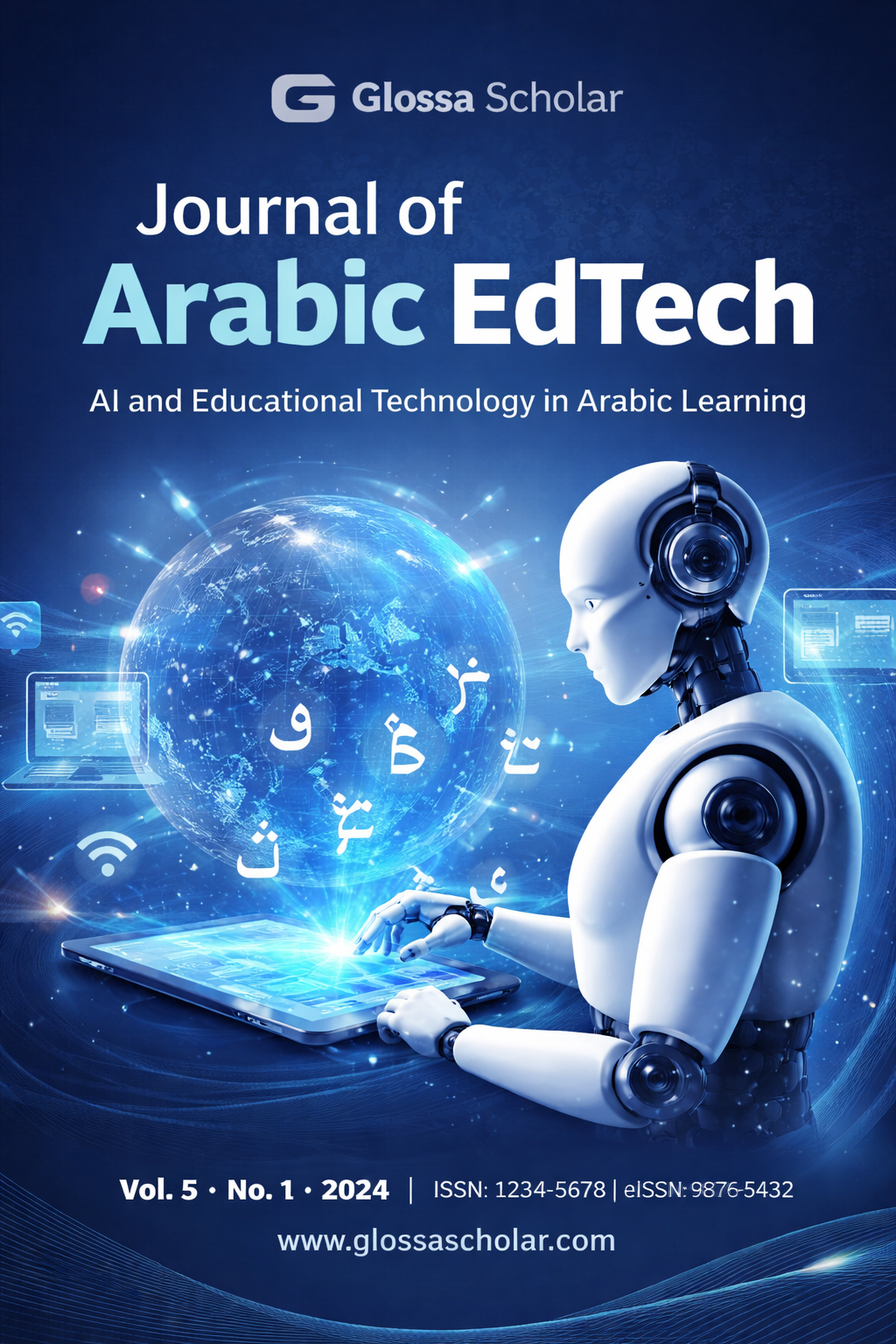
Journal of Arabic EdTech (JAET)
Journal of Arabic EdTech (JAET) is an international, peer-reviewed, open-access scholarly journal published biannually (May and September). The journal is dedicated to advancing high-impact research at the intersection of Arabic language education, educational technology, artificial intelligence, and digital transformation in learning.
JAET is strategically positioned as a global platform for rigorous academic discourse and innovation in Arabic Educational Technology. The journal seeks to contribute to the international body of knowledge by publishing research that demonstrates strong theoretical grounding, methodological robustness, and practical implications in technology-enhanced Arabic language education.
JAET welcomes contributions from researchers, scholars, and practitioners worldwide and actively promotes cross-regional and interdisciplinary collaboration.
Aims and Strategic Positioning
JAET aims to:
-
Become a leading international reference in Arabic Educational Technology
-
Promote methodological rigor and innovation aligned with global research standards
-
Bridge Arabic linguistics, pedagogy, assessment, and AI-driven systems
-
Support digital transformation initiatives in language education
-
Foster international collaboration and comparative research
The journal prioritizes research with strong empirical evidence, advanced statistical analysis (e.g., CTT, IRT, learning analytics), experimental or quasi-experimental designs, AI-supported adaptive systems, and scalable educational innovations.
Publication Frequency
JAET is published twice annually:
-
May
-
September
Each issue is curated to ensure consistency, scholarly depth, and international relevance.
Scope of the Journal
JAET publishes high-quality scholarly works, including:
-
Original empirical research
-
Experimental and quasi-experimental studies
-
Design-based research
-
Systematic reviews and meta-analyses
-
Theoretical and conceptual frameworks
-
Technology development reports with validation data
-
Assessment validation and psychometric studies
Core Areas of Interest
-
Artificial Intelligence in Arabic Language Learning
-
Adaptive Learning Systems and Intelligent Tutoring
-
Arabic Language Proficiency Testing and Digital Assessment
-
Learning Analytics and Educational Data Mining
-
Mobile-Assisted Arabic Language Learning (MALL)
-
Blended and Online Learning Models
-
Gamification and Human–Computer Interaction in Language Learning
-
Arabic NLP, Corpus Development, and Language Technology
-
Curriculum Innovation and Instructional Design
-
Technology-Enhanced Teacher Education
Editorial and Ethical Standards
JAET operates under a rigorous double-blind peer review process, ensuring fairness, academic integrity, and international scholarly standards.
All submissions undergo:
-
Initial editorial screening (scope, originality, quality threshold)
-
Double-blind review by at least two qualified reviewers
-
Final decision based on reviewer evaluation and editorial assessment
The journal adheres to international publication ethics and best practices in scholarly publishing.
Open Access and Licensing
JAET is a fully Open Access journal under the Creative Commons Attribution (CC BY) License, ensuring global accessibility, citation visibility, and knowledge dissemination without barriers.
Internationalization Strategy
JAET is committed to:
-
Diversified international editorial board representation
-
International authorship and reviewer distribution
-
Cross-country research collaboration
-
Global indexing roadmap
-
Compliance with international publishing standards
The journal actively works toward inclusion in major indexing databases and aims to achieve sustainable international impact and citation growth.
Why Publish in JAET?
-
International peer-reviewed journal
-
Biannual regular publication (May & September)
-
Strong positioning in AI and educational technology
-
High methodological standards
-
Transparent editorial process
-
Strategic indexing roadmap
-
Global academic visibility
Current Issue
Vol. 1 No. 1 (2026): Inaugural Issue (Volume 1, Number 1)
Journal of Arabic EdTech proudly presents its inaugural issue, Volume 1, Number 1, as the first scholarly publication dedicated to advancing research at the intersection of Arabic language education, educational technology, artificial intelligence, digital pedagogy, and assessment innovation.
As an international peer-reviewed journal published through Glossa Scholar, this inaugural issue marks an important academic milestone in building a global platform for researchers, lecturers, educators, practitioners, and technology developers who are concerned with the transformation of Arabic language teaching and learning in the digital era.
The journal welcomes original research articles, conceptual papers, literature reviews, case studies, and development-based studies that explore how technology can enhance Arabic language education across various learning contexts, including schools, pesantren, universities, online learning environments, and non-native Arabic learning communities.
This first issue particularly focuses on emerging discussions related to AI-assisted Arabic learning, digital learning media, learning management systems, computer-based Arabic assessment, adaptive testing, digital pedagogy, and the integration of technology into the teaching of Arabic language skills such as listening, speaking, reading, writing, grammar, vocabulary, and Arabic for specific purposes.
Through this inaugural publication, Journal of Arabic EdTech aims to contribute to the development of a strong academic ecosystem in Arabic educational technology and to encourage innovative, ethical, and evidence-based practices in Arabic language education.
Published: 2026-07-21